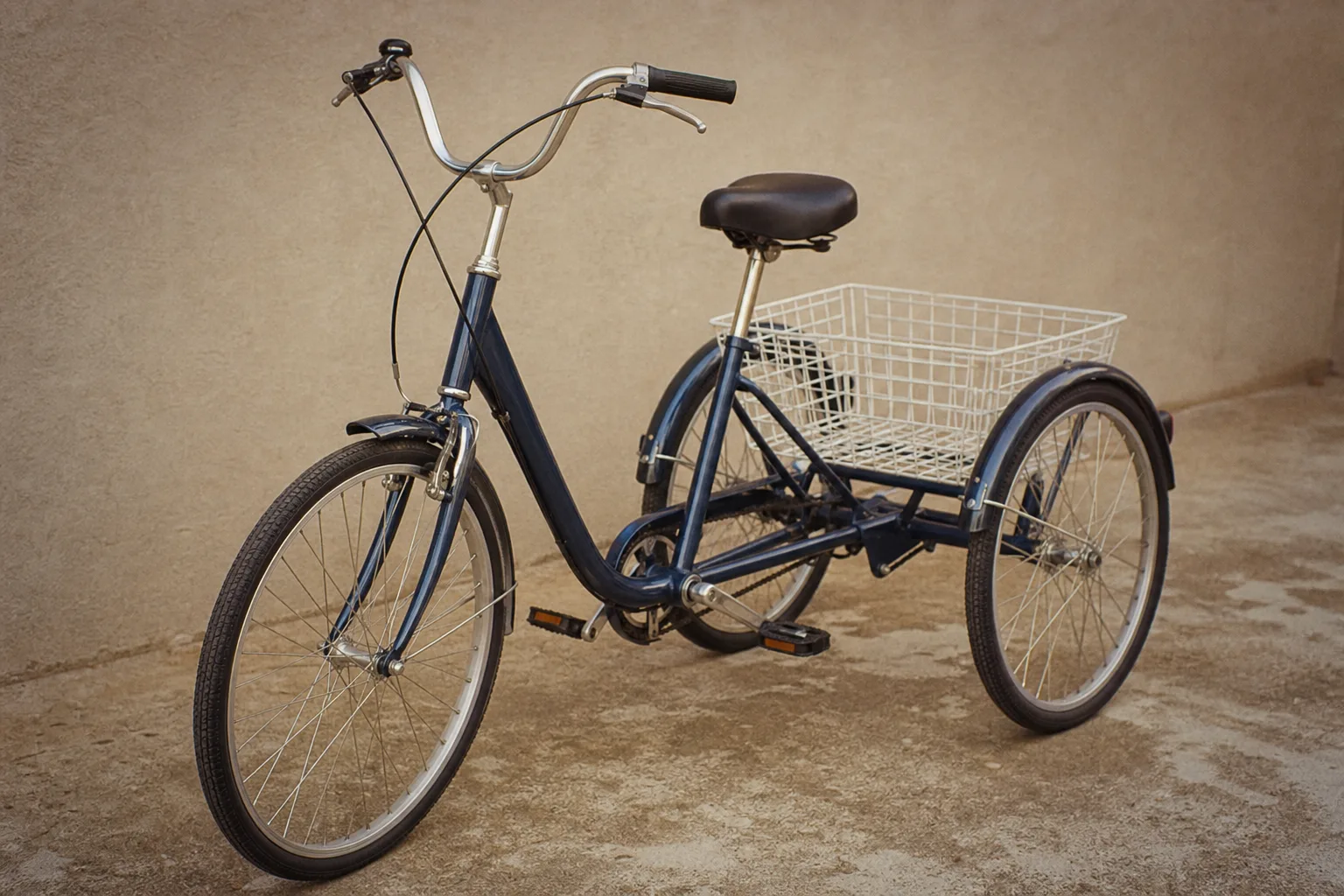
A trike is stable standing still and behaves differently in a turn, and the fittings that fix that (track width, seat height, gearing) are where the real money goes.
A bicycle stays upright because the rider keeps falling and correcting, a hundred small steers a minute that nobody notices until balance stops arriving on time. A trike removes that job entirely. Stop pedaling at a curb, put both feet on the pedals, and nothing happens: no wobble, no lurch toward the gutter, no scramble for a foot down. That single change is why most people arrive at three wheels, and it is genuinely what it promises. What it does not do is make the machine a bicycle with a spare wheel, because the moment the road bends, a trike asks something different of you.
The lean is gone, and the weight has to go somewhere
On two wheels, a turn is a controlled fall. The rider leans in, the frame leans with them, and the combined force of gravity and cornering runs straight down through the tires, which is why a bicycle can round a corner briskly without feeling as though it is being pushed anywhere. A trike cannot lean. The frame stays flat and the cornering force has to be resisted by the wheels themselves, which means weight shifts off the inside wheel and piles onto the outside one. Take a corner too fast and the inside rear wheel gets light, then leaves the ground. That is the entire cornering lesson, and it is learned in about ten minutes of deliberate practice in an empty parking lot.
The correction is undramatic. Slow before the turn rather than during it, lean your upper body toward the inside of the corner while the frame stays level, and keep pedaling smoothly through the arc instead of coasting. Riders who came from motorcycles find this backwards at first, because the body motion is the opposite of countersteering. Riders who came from a bicycle after a fall usually find it easier, since they have already stopped trusting speed. Either way it becomes automatic, and after a week most people stop thinking about it at all.
Crowned roads tilt the whole machine
American streets are built with a crown, a slight hump down the centerline that sheds rainwater toward the curb. A bicycle absorbs that slope invisibly, because the rider simply leans a fraction to compensate and never registers it. A trike sits flat across the road surface, so the crown tilts the entire vehicle toward the gutter, and the steering pulls that way with it. On a well-graded street the pull is mild and one hand corrects it. On a badly cambered shoulder, a driveway apron, or a section of pavement that has settled, it is strong enough to be tiring over a few miles.
This is why the first ride should not be on a road at all. A wide, flat path, a school lot on a weekend, or a park loop gives you the cornering and the camber lessons separately rather than at once. It also explains why some riders end up preferring a lower, wider machine even though it is harder to store, since a lower center of mass and a wider stance blunt both effects considerably.
Track width and seat height decide how the first ride feels
Two measurements do most of the work. Track width is the distance between the centers of the two rear wheels, and it sets how far the machine can tilt before the inside wheel unloads. Seat height, more precisely the height of the rider's combined center of mass above the road, sets how much leverage the cornering force has to work with. A tall upright trike with a narrow track is easy to store, easy to mount, and twitchy in a turn. A wide, low machine is planted and confident, and then it does not fit through a standard gate. Almost every design decision in this category is a trade between those two facts, and the honest answer depends on where the trike lives and where it is ridden.
The Consumer Product Safety Commission oversees safety requirements for bicycles and adult tricycles sold in the United States, which covers braking, reflectors and assembly, but no standard can tell you whether a given track width suits your driveway. That part is measured with a tape at home before anything is ordered.
What the decision actually costs
The purchase price is the smallest surprise. Assembly is the first cost, because most machines ship partly built in a box that two people struggle to move, and a shop will charge for a proper build and a brake bleed. Then come the fittings that turn a workable trike into one you use: a mirror, since you cannot shoulder-check the way you did on a bicycle, a basket sized to what you actually carry, sometimes a different seat, sometimes lower gearing. Storage is often the largest line item of all, because a wide machine may need a shed, a ramp, or a rearranged garage. Riders comparing electric tricycles should add battery replacement to that arithmetic, since a pack is a consumable with a service life measured in charge cycles.
What the rest of this site covers
The sections here follow the order the questions actually arrive in. How much motor a loaded trike needs, and when no motor is the right answer. Where the machine will live, measured against real doorways, shed openings and car trunks. What wears out first, from rear hub bearings to the single-sided drivetrain, and who in your area will service it. Each is written from measurements and receipts rather than specifications, because the specification sheet is the one document that never mentions the gate.
Ride it once on flat ground before deciding anything. Twenty minutes of turning circles in a quiet lot will tell you more about track width and seat height than any comparison chart, and it costs nothing but the trip.