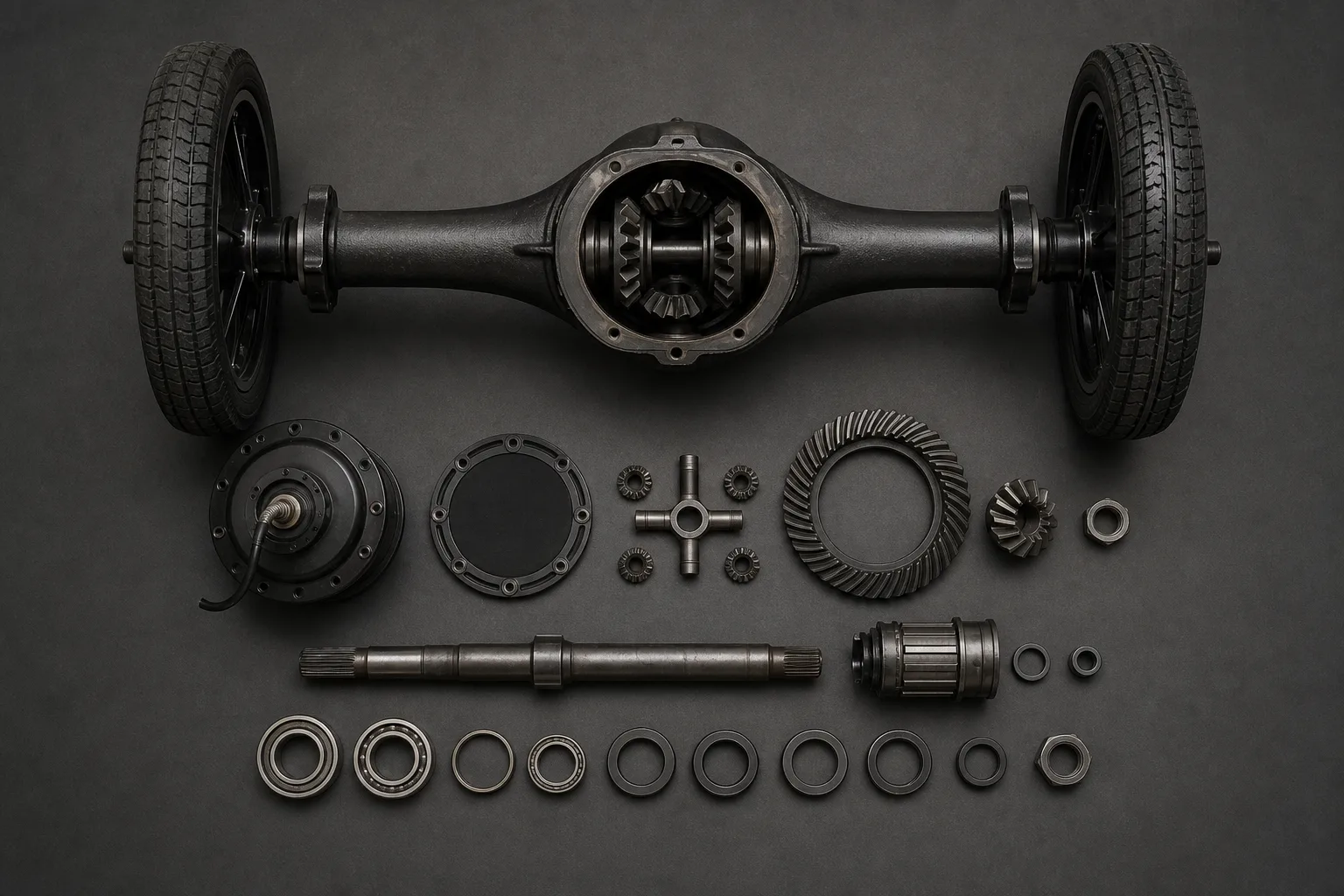
The purchase price of an adult three-wheeler is a single number, easy to compare across brands, and it tells you almost nothing about what the machine will cost to keep. What matters more is the answer to two quieter questions: which components on this particular design are consumable, and who within driving distance is willing to touch them. A trike is not a bicycle with an extra wheel. It has a drivetrain that ends differently, a mass that punishes brakes, and, on electric models, a battery that is effectively a wear item with a finite supply chain. A careful reader checks these before handing over money, not after.
1. The rear axle, and whether power reaches one wheel or two
Most inexpensive trikes drive a single rear wheel. The other rear wheel spins free, which keeps the parts count low and the cost down, at the price of traction on loose ground and a slight pull under hard pedaling or motor torque. The alternative is a differential, a gear set that splits drive between both rear wheels while letting them turn at different speeds through a corner. Differentials are the better ride and the harder repair. Ask which one you are buying, ask whether the differential is a sealed cartridge or a serviceable assembly, and ask what a replacement costs as a unit, because on many models that is the only way it is sold.
2. Wheel sizes that no shop keeps in stock
Two-wheel bicycles have converged on a handful of rim and tire sizes, so a flat is a twenty-minute problem anywhere. Trikes have not converged. Rear wheels are frequently 20 inch, sometimes in a width or bead seat that a general shop has never ordered, and the rear hubs are often proprietary: one-sided axles, keyed hubs, drum brake shells that only fit the manufacturer's wheel. That means a bent rim is not a wheel swap from the wall rack but a special order. Before buying, get the exact tire size printed on the sidewall and check that a common brand makes a tire in it, then confirm the manufacturer sells complete replacement rear wheels rather than only frames and fenders.
3. Brakes doing more work than they were designed for
A loaded trike with a rider, groceries and a battery is heavy, and heavy machines eat brake pads. On a trike the front brake cannot be leaned into the way it can on a bicycle, so more of the stopping falls to the rear, where drum or disc hardware is often the least accessible part of the vehicle. Expect pad and rotor intervals shorter than you are used to, expect cable-actuated systems to need more frequent adjustment as the pads wear, and budget for that as routine rather than as a failure. The good news is that brake parts are the cheapest and most widely stocked item on the whole list, provided the machine uses standard disc calipers and rotors, which is worth confirming in writing.
4. The battery, which is a consumable with a supplier attached
An electric trike's battery loses capacity with cycles and age, and at some point it needs replacing rather than charging. The cost is a meaningful fraction of the machine's price, and the availability depends entirely on whether the manufacturer still sells that pack in that case with that connector. Generic replacements rarely fit. Ask the seller directly whether a replacement pack is currently listed for sale, what it costs today, and how long the model has been in production, since a pack shared across several model years is a far safer bet than one unique to a single run. The Consumer Product Safety Commission oversees safety requirements for these products in the United States, which is one reason to buy a pack from a company that will still be answering the phone.
5. The shop, found before you need it
Many bicycle shops decline trike work, and their reasons are practical rather than snobbish: the machines do not fit standard repair stands, they occupy floor space a shop does not have, and the mechanic has no parts bin for hubs and axles that appear once a year. Call two or three shops near you, name the exact model, and ask whether they will service it. A yes from a local shop is worth real money at purchase time. So is a manufacturer that publishes an exploded parts diagram, sells individual components online, and answers technical email, because that combination lets any competent mechanic help you even when the shop has never seen the model before.
The trikes that stay on the road for a decade are usually not the cheapest ones. They are the ones whose owners knew, on the day of purchase, where the spare rear wheel comes from and what the next battery will cost.